
Blooming
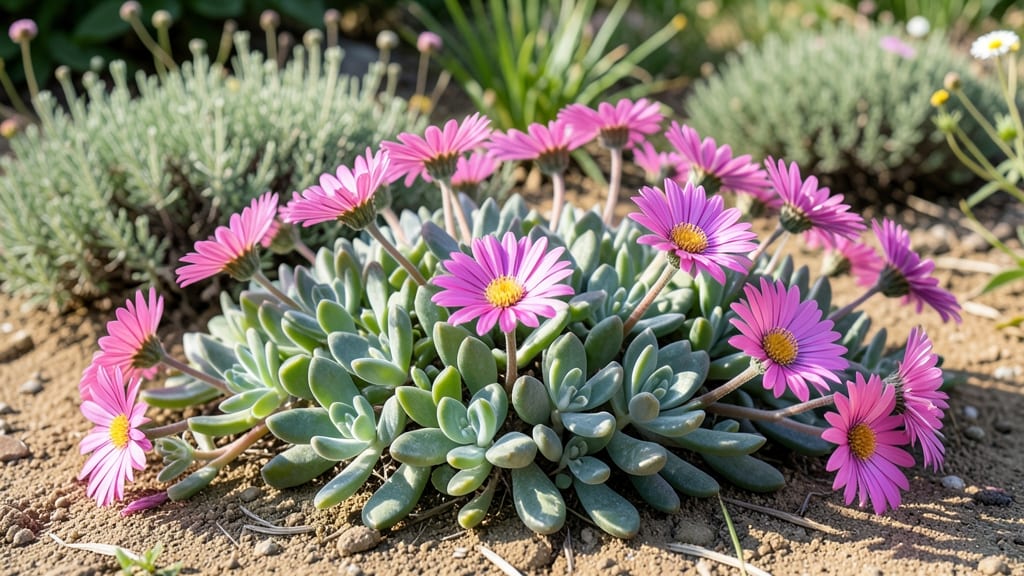
Your ice plant 🌸 blooms when the heat triggers its natural cycle, typically between late spring and early fall, but the exact timing depends on your variety and climate.
If you’ve ever waited all summer for those vibrant daisy-like flowers only to be left with lush green foliage, you’re not alone. Ice plants (Delosperma and Lampranthus) are finicky about temperature cues—most need four weeks of consistent 70°F+ days before they’ll even think about flowering.
This guide breaks down the heat-triggered stages of ice plant blooming, from bud formation to peak color, and reveals how to nudge your plant into action—whether you’re in a hot desert zone or a cooler coastal area.
You’ll also discover why some varieties bloom earlier than others, how sunlight and soil play a role, and the three simple fixes that turn a no-show into a showstopper by midsummer.


When do ice plants bloom? Exact months by variety & climate zone
Ice plants (Delosperma and Lampranthus varieties) are famous for their vibrant, heat-loving blooms, but their exact timing depends on your USDA zone and the specific variety. Unlike many flowers, ice plants bloom in response to prolonged warmth (70°F+ for 4+ weeks), not seasonal cues.
This means coastal gardens may bloom earlier than desert areas—even in the same zone—due to temperature fluctuations. Let’s break down when to expect those stunning daisy-like flowers by variety and region.
Most ice plants follow a predictable cycle: they wait until consistent heat triggers bud formation, then bloom for 6–8 weeks before entering dormancy. In USDA zones 7–10, blooming typically starts between late spring and early fall, but exact months vary.
For example, Delosperma cooperi (a popular variety) often blooms from May to July in zone 9, while Lampranthus spectabilis might extend into September in zone 10. Understanding these windows helps you plan companion plants and maintenance.
If you’re in a coastal climate (e.g., Southern California or Pacific Northwest), expect blooms to shift 1–2 months earlier due to milder summers. For example, Delosperma cooperi might bloom in April–June in zone 9 near the coast, while inland areas see flowers in May–July.
Conversely, desert regions (like Arizona or Nevada) often push blooms into late summer or fall because extreme heat delays initial bud formation until temperatures stabilize.
For USDA zone 7, where winters are cooler, ice plants may not bloom until June or July, as they need to survive the first heatwave of the season.
In zone 10, blooming can extend into November, especially for varieties like Lampranthus spectabilis, which thrive in consistent 80°F+ temperatures. Always monitor your local minimum nighttime temperatures—ice plants often need nights above 55°F to set buds successfully.
Pro tip: Use a garden thermometer to track daily highs. Once temperatures hit 70°F for 4+ consecutive weeks, your ice plant’s foliage will thicken slightly, and you’ll see tiny buds forming at stem tips.
This is your cue to reduce watering slightly—drought stress triggers more vibrant blooms. Overwatering at this stage can delay or even prevent flowering entirely.
Some gardeners in warmer zones (9–10) report two bloom cycles per year: one in spring and another in fall. To encourage this, prune back spent blooms by 1/3 after the first flush and fertilize lightly with a low-nitrogen formula (5-10-10).
This mimics their natural desert cycle, where rainfall (or watering) triggers regrowth followed by another bloom phase.
For container growers, timing is even
5 Heat-triggered stages of ice plant flowering (and how to speed them up)
Ice plants (Delosperma and Lampranthus) don’t bloom on a calendar—they follow a heat-triggered schedule tied to temperature thresholds. Understanding these 5 physiological stages lets you predict blooms and even accelerate them by 3–6 weeks. Here’s how to recognize each phase and what to do at every step.
The process begins when daytime temps hit 70°F+ consistently for 4+ weeks, signaling your ice plant to shift from vegetative growth to bud formation. This is your first clue that flowering is imminent.
Pay attention to leaf color shifts—healthy green foliage may develop subtle purple or red tinges as energy redirects to flower production.
- 🌱 Stage 1: Bud Initiation – Leaf color shifts to purple/red; stem elongation begins (2–3 weeks). Action: Reduce watering to 50% capacity to mimic desert stress.
- 🌿 Stage 2: Bud Swelling – Tight buds form; stems thicken (1–2 weeks). Action: Apply low-nitrogen fertilizer (5-10-10) to support bloom development.
- 🌸 Stage 3: Bloom Opening – First flowers unfurl (3–5 days). Action: Prune spent blooms daily to extend flowering by 4+ weeks.
- 🌺 Stage 4: Peak Bloom – Full color display (2–3 weeks). Action: Use 50% shade cloth in afternoon to prevent heat stress.
- 🌼 Stage 5: Senescence – Flowers fade; stems yellow (1–2 weeks). Action: Deadhead aggressively to encourage reblooming in fall.
At Stage 1 (Bud Initiation), your ice plant is most sensitive to environmental cues. If you notice stunted stem growth or buds failing to form, check for overwatering—ice plants thrive on controlled drought stress.
Let the soil dry completely between waterings, and avoid wetting foliage to prevent fungal issues.
By Stage 3 (Bloom Opening), your ice plant’s flowers will reveal their true colors, but this is also when pruning becomes critical. Remove spent blooms immediately—this redirects energy to new buds and can extend the flowering season by up to 6 weeks.
Use clean, sharp shears to avoid damaging stems, and discard pruned material to prevent disease.
Don’t let Stage 5 (Senescence) signal the end of your ice plant’s performance. Many varieties, like Lampranthus spectabilis, will rebloom in fall if given the right care.
After the last flower fades, apply a balanced fertilizer (5-10-10) and reduce watering to prepare the plant for its winter dormancy period.
Pro tip: If your ice plant skips a stage—say, buds form but never open—it’s often due to nutrient deficiencies. A quick soil test can reveal if your plant needs phosphorus (for blooms) or potassium (for stress resistance).
Amend with compost or a bloom-boosting fertilizer to jumpstart the next cycle.