
Blooming
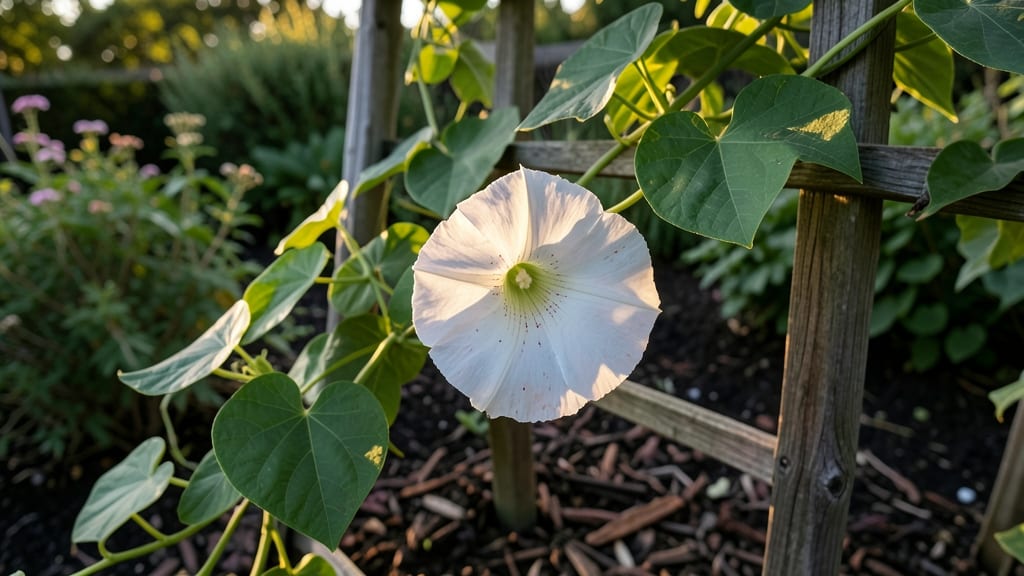
Moon flowers bloom at night because their petals respond to low-light conditions, triggered by natural circadian rhythms and cooler evening temperatures, creating their signature nocturnal beauty. They close by dawn when sunlight increases.
This unique blooming pattern isn't just about aesthetics—it's a survival strategy. 🌙 Moon flowers, like night-blooming jasmine, evolved to attract nocturnal pollinators such as moths and bats, which are drawn to their sweet fragrance after sunset.
The cooler nighttime temperatures actually help the petals stay hydrated longer, while the darkness prevents excess water loss that would occur in daytime heat.
Interestingly, these flowers have been cultivated for centuries in regions with distinct day-night temperature swings, where the contrast between warm days and cool nights creates perfect blooming conditions.
What makes this even more fascinating is how sensitive they are to light exposure. Even artificial lighting can disrupt their natural cycle, causing them to open prematurely or fail to close properly.
This is why gardeners in urban areas often struggle to get consistent nighttime blooms—the city lights confuse their internal clocks. The key to encouraging healthy nocturnal displays lies in recreating their natural environment as closely as possible.
💡 In This Article
- Why Moon Flowers Follow a Nocturnal Blooming Cycle
- Gardening Tips to Maximize Moon Flower Nighttime Blooms
Why moon flowers follow a nocturnal blooming cycle
The secret behind moon flowers' nighttime display lies in their biological clock—specifically, a process called photoperiodism. These plants detect changes in daylight length through specialized cells called phytochromes, which act like internal light sensors.
When daylight fades below 12 hours, these sensors trigger a cascade of biochemical reactions that signal the petals to unfurl. This is why moon flowers typically bloom in late spring to summer, when nights are long enough to create the perfect 10-12 hour darkness window they need.
Temperature plays an equally crucial role. Moon flowers thrive in regions where daytime temperatures reach 75-85°F while nighttime dips to 60-68°F. This 10-15°F temperature drop helps the petals stay pliable and hydrated, preventing the wilting that would occur in continuous heat.
The cooler nights also slow down metabolic processes, allowing the flower's energy to focus on opening rather than photosynthesis. Interestingly, this temperature sensitivity explains why moon flowers often fail to bloom well in tropical climates where night and day temperatures remain nearly identical.
Moonlight itself isn't the direct trigger—it's the absence of sunlight that matters. These flowers have evolved to avoid daytime pollinators like bees, instead attracting moths and bats that are active after dark.
The petals contain compounds that become more aromatic in low light, releasing a sweet, jasmine-like fragrance that can be detected up to 50 feet away by nocturnal visitors. This evolutionary adaptation creates a perfect mutualism: the flowers get pollinated, and the pollinators get a nighttime meal.
What makes moon flowers unique compared to diurnal bloomers is their reversible petal mechanism. While roses or sunflowers open permanently, moon flowers have specialized cells that absorb water during the day (keeping petals closed) and release it at night (triggering expansion).
This process is controlled by hormones like auxin, which accumulates during darkness and causes the petal cells to elongate. By dawn, the auxin levels drop, and the petals begin to close as water is reabsorbed.
This nocturnal cycle also serves as a built-in survival strategy. The closed petals during daylight protect the flower's delicate reproductive parts from UV radiation and high temperatures, which could damage pollen or nectar.
The trade-off is that moon flowers must complete their entire pollination process within a single night—any disruption (like early morning light) can leave them vulnerable to missed pollination opportunities.
For comparison, consider how roses bloom in the morning when bees are most active—their petals are thick and waxy to withstand daytime conditions. Moon flowers, by contrast, have thinner, more delicate petals optimized for nighttime conditions.
This structural difference explains why you'll rarely see a moon flower thriving in a full-sun garden bed where daytime heat would stress its delicate physiology.