
Blooming
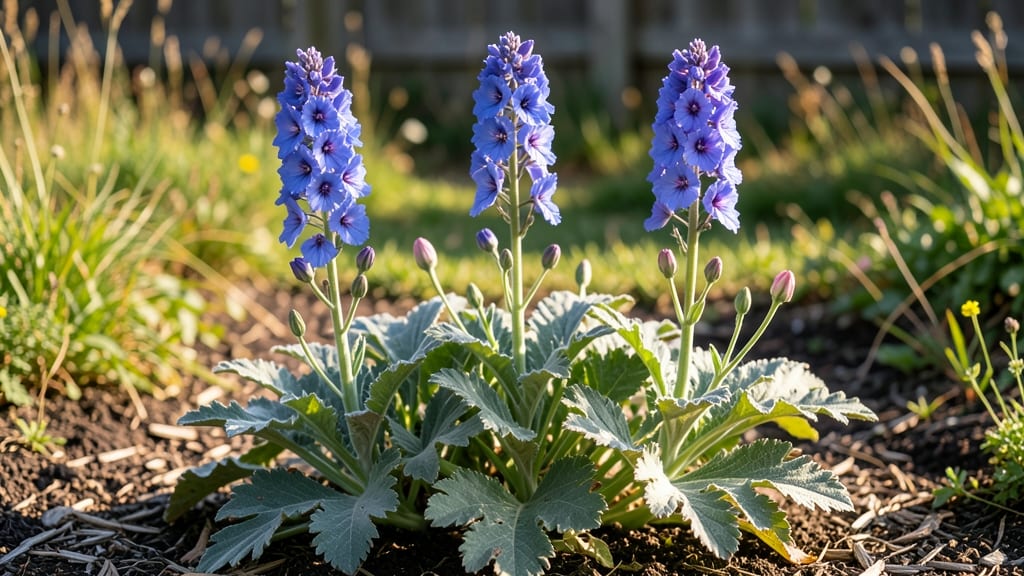
Delphiniums do not bloom all summer continuously; they typically flower in spring and early summer, though some heat-tolerant varieties may rebloom with proper deadheading and care.
Most delphiniums thrive as cool-season plants, so their flowering naturally slows or stops when temperatures climb above 75°F. 🌸 The key to extending their season is choosing the right variety—some hybrids like 'Pacific Giant' or 'Black Night' are bred to handle warmer weather better.
I've found that regular deadheading (removing spent blooms) can encourage a second flush of flowers in late summer, especially if you maintain consistent moisture and feed with a phosphorus-rich fertilizer every 4-6 weeks.
What really makes a difference is understanding your local climate. In cooler regions, delphiniums may bloom almost nonstop from spring to fall, while hotter zones might only see vibrant displays in spring with minimal reblooming.
The secret lies in balancing sunlight, water, and soil health—delphiniums need well-draining soil and at least 6 hours of sunlight daily to perform their best.
💡 In This Article
- Delphinium Bloom Cycles by Variety and Climate
- Extending Delphinium Blooms: Pruning, Deadheading, and Soil Secrets
Delphinium bloom cycles by variety and climate
Delphiniums are day-length sensitive plants, meaning their flowering is triggered by changes in daylight rather than just temperature. Most varieties follow a vernalization pattern—requiring cool temperatures (40-50°F) for several weeks to break dormancy before blooming.
This is why you'll see peak flowering in spring when days lengthen gradually. 🌿 For example, 'Blue Bird' delphiniums typically bloom from May to June in USDA zones 3-8, while 'Black Knight' varieties may extend into July with proper care.
The science behind this involves photoperiodism—the plant's internal clock responds to increasing daylight hours (longer than 14 hours) to initiate flower buds. Heat-tolerant hybrids like 'Pacific Giant' have been bred to handle 75-85°F temperatures better by developing thicker waxy coatings on leaves that reduce water loss.
However, even these varieties often enter a summer dormancy when temperatures exceed 85°F for extended periods, causing buds to drop before opening.
Climate plays a huge role in bloom duration. In cooler coastal regions (like Pacific Northwest), delphiniums may bloom continuously from spring to early fall due to moderate temperatures and consistent moisture.
Conversely, in hot inland areas (such as the Southwest), most varieties complete their bloom cycle by early summer and go dormant until fall rains trigger new growth. The key difference is soil moisture retention—delphiniums wilt quickly in dry heat, signaling the plant to conserve energy by halting flower production.
Day-length also affects reblooming potential. Short-day varieties (common in tropical regions) may produce a second flush in late summer if day lengths shorten slightly, while long-day types (more common in temperate zones) rarely rebloom naturally.
This is why gardeners in USDA zones 5-7 often see better results with deadheading—removing spent blooms redirects the plant's energy toward new growth rather than seed production.
Consider these variety-specific bloom patterns:
- Early bloomers: 'Blue Bird' (May-June), thrives in zones 3-8 with 5-6 hours of morning sun
- Mid-season: 'Black Knight' (June-July), heat-tolerant up to 85°F with afternoon shade
- Late-season: 'Pacific Giant' (July-August), extends blooming with consistent 1-inch weekly watering
The most critical factor is temperature fluctuations**—abrupt heat spikes above 90°F can cause bud blast (dropped buds) within 48 hours, while gradual cooling in fall often triggers a second bloom cycle. 🌡️ This is why gardeners in transition zones (like zone 7b) often get the longest bloom seasons with proper care.